
Knowledge, Expertise, Innovation
PIPE CLAMP TOOLING
Three mold systems.
One clamp, Your Design.
The mold determines how accurate, fast, and repeatable every pipe clamp is. Compare our Modular Progressive Twin, Modular Progressive Single and Monoblock sets, for any models and any sizes.
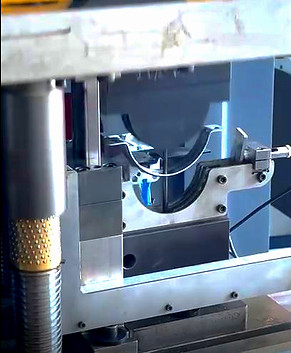
Compare the Three Systems
Cutting, punching and bending are done on every die type, and the clamp design of your choice can be built into any of them.
Progressive Modular Twin
Body and cover parts of pipe clips are pressed together as a two-piece set in one stroke.
160 t
Feed
2 PLC Servo Drivers + 2 Uncoilers
Sizes
3/8" to 6"
Mold Protection
Avaliable
Operator
Professional mold operator required
Progressive Modular Single
One piece of Pipe Clips part (body or cover) in each stroke. Easy to run and maintain.
125 t
Feed
1 PLC Servo Driver + 1 Uncoiler
Sizes
3/8" to 6"
Mold Protection
Avaliable
Operator
Less expertise than Twin
Progressive Monoblock
Fixed one-piece mold. Double-cavity up to 2", Single-cavity above.
125 t
Feed
1 PLC Servo Driver + 1 Uncoiler
Sizes
3/8" to 6"
Mold Protection
Not Avaliable
Operator
Needs little expertise beyond mounting
Some differences between die types
Progressive Modular Twin

Progressive Modular Single

Progressive Monoblock

Mold Changeover Time
Very short: swap only the internal inserts
Very short: swap only the internal inserts
Longer: the entire mold must be removed
Output per stroke
Two pieces (body and cover)
One piece
Two pieces up to 2", one piece above 2"
Repair time
Short: replace only the failed module
Short: replace only the failed module
Long: full disassembly needed
Spare part cost
Low, e.g. a broken bending module
Low, e.g. a broken bending module
The whole mold must be removed if a part breaks
Dimension tuning
Adjustable hole centers, tab lengths, asymmetric ears
Adjustable hole centers, tab lengths, asymmetric ears
No adjustment possible
Future models
New models, sizes or types (e.g. heavy duty) can be adapted
New models, sizes or types (e.g. heavy duty) can be adapted
No later changes
Operation
Professional mold operator
Easier to operate and maintain
Minimal skill beyond mounting
Mold protection
Press stops on die breakage, failed ejection or end of sheet metal
Press stops on die breakage, failed ejection or end of sheet metal
None
What is a progressive die?
A progressive die pulls a metal strip through a series of stations. Each press stroke advances the strip one step, so every station works at once and a finished part leaves with every stroke.
For pipe clamps, this means holes, notches and bends are made in one continuous run, and every clamp comes out to the same measurements.
1
Strip feed
A servo feeder advances the coil by an exact pitch each stroke.
2
Piercing and punching
Holes and slots are cut at the first stations.
3
Bending and forming
The next station forms the pipe clamp. Sahping the product.
4
Cut-off and ejection
The pressed clamp parts is separated and leaves the die.
5
Die protection
Sensors stop the press if strip, part or die in any error.
Modular Means Fast Size Changes
Each pipe size uses its own set of inserts. Change the inserts instead of the whole mold, and replace any worn module on its own.
Quick switching times between sizes.
A structure open to product diversification through future additions.
A strong structure suitable for fine-tuning.
Machined bending inserts, one per size step

Machined Modular Mold bending inserts, one per size step
